Field Note
Can You Predict a Wildebeest River Crossing?
What Four Days on the Mara River Taught Me About Waiting, Prediction, and Wildlife Photography
By Nature Zi — wildlife photographer and safari guide based in Nairobi, Kenya, with 15 years of field experience across East Africa, including the Maasai Mara and Serengeti.
Short answer
A wildebeest river crossing on the Mara River can be predicted to a degree, but never guaranteed.
Photographers can raise their odds by reading the herd — how many animals have gathered, which direction they are moving, whether more groups are still arriving, whether the first animals entering the water are being followed, and whether hesitation is beginning to turn into collective movement.
But even a strong prediction can fail.
In my own field record, roughly four out of every ten situations I judged “highly likely” still ended without a crossing. That is not a scientific probability. It is a record of my own field judgement.
That is why I plan four days at the river, not one.
What I look for before a Mara River crossing
Before I believe a crossing may be close, I watch six things:
- Herd size near the river.
- Direction of movement — toward the bank, away from it, or parallel to it.
- New groups continuing to arrive from behind.
- Animals beginning to enter the water.
- Whether other wildebeest follow those first animals.
- Whether repeated hesitation is beginning to turn into collective movement.
None of these signs guarantees a crossing.
Together, they help me decide whether it is worth continuing to wait.
Most people know the Great Migration from one kind of photograph: thousands of wildebeest pouring into a river, water thrown up around them, crocodiles waiting below, dust hanging over everything.
It looks like something that happens on cue.
Stand beside the Mara River long enough and you learn otherwise.
Wildebeest don’t cross on a schedule. They don’t care that you’ve already waited three days, and they don’t owe you a crossing on the fourth.
This migration season I led four Great Migration photography groups, and all four eventually saw river crossings. Between them I watched two at Kenya’s Sand River and five in the northern Serengeti around the Mara River.
The smallest involved just 13 animals.
The largest involved more than 30,000 wildebeest and continued for roughly 25 minutes.
There were days when we saw three separate crossings.
But two of my groups also sat beside the river for three full days without seeing one, and only got their crossing on day four.
So when photographers ask me whether a wildebeest crossing can be predicted, my answer is:
To a degree, yes. Guaranteed, never.
Does Seeing Wildebeest at the River Mean They Are About to Cross?
No.
Wildebeest gathered at the Mara River are a precondition for a crossing, not a promise of one.
When I arrive at the river, the first thing I look at isn’t my camera.
It’s the herd.
How many animals have gathered near the water?
Which way are they actually heading — toward the bank, or parallel to it?
And further out: are more groups still arriving from the distance?
That last question matters more than people think.
A herd that is still being fed by new groups arriving from behind feels very different from one that has stopped growing.
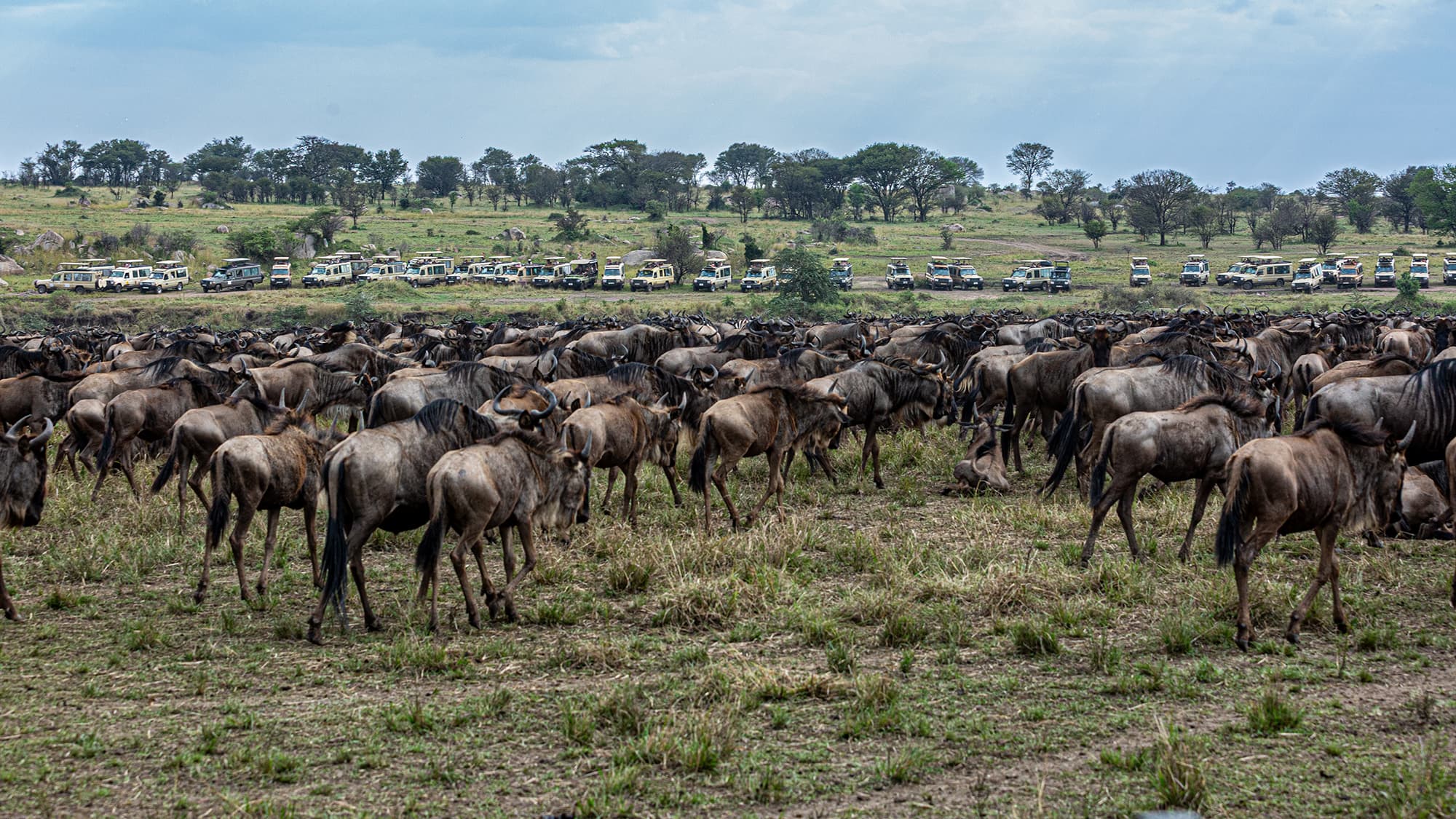
Sometimes thousands of wildebeest are already standing close to the river and the scene looks perfect. Everyone gets excited. Cameras come up. Drivers begin watching the herd more closely.
You think:
This is it.
Then the animals walk to the edge.
Stop.
Back off.
They approach again.
They drift along the bank and test another place.
Then another.
And sometimes, just as everyone becomes convinced the crossing is about to begin, the entire herd turns and walks away.
I have seen this often enough that I stopped reading every approach to the water as the beginning of a crossing a long time ago.
A Herd Is Not One Mind
From a distance, several thousand wildebeest packed together can look like a single organism.
They aren’t.
In the field I routinely see different parts of the same aggregation doing different things.
Some animals are pushing toward the river.
Others are hanging back.
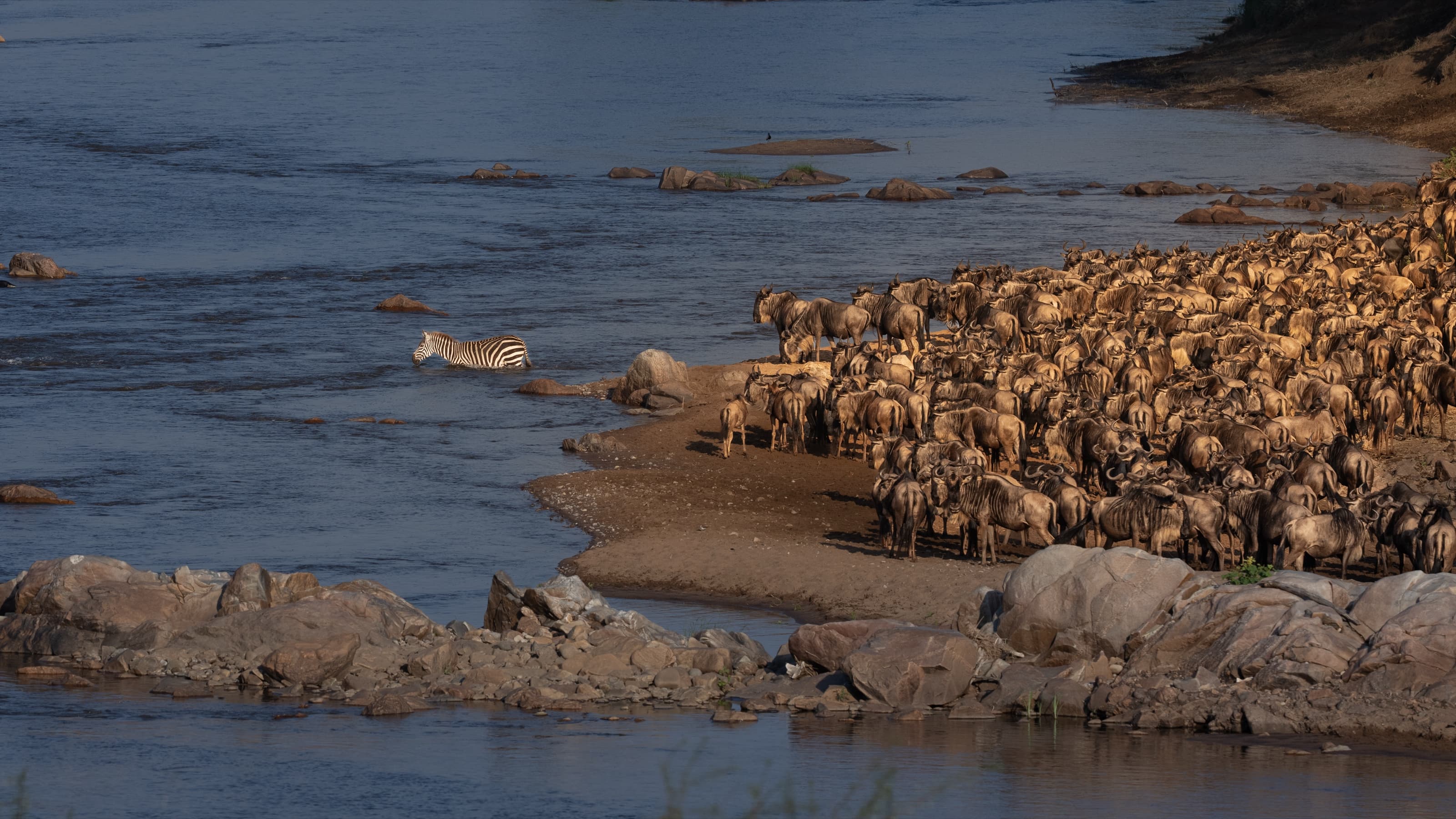
A few individuals approach the water first.
Some follow.
Others turn around altogether.
Research into wildebeest movement supports a more dynamic picture of these enormous aggregations rather than the idea of a single, tightly coordinated herd making one decision at once. Studies of collective movement also suggest that social information — what other animals are doing — can contribute to how movement spreads through groups.
That is why I am careful with the word leader.
In the field we often talk about a “lead wildebeest,” but I prefer to think of certain animals as initiators — individuals that begin a movement others may or may not follow.
Being first does not make one animal a permanent leader deciding for thousands.
What matters is what happens next.
Do others follow?
Does the movement spread?
Does hesitation continue?
Or does hesitation begin turning into momentum?
That distinction matters.
Because one animal walking into the river is interesting.
Twenty animals walking in together is something else.
How Many Wildebeest Have to Enter the Water Before a Crossing Is Real?
This is one of the most useful field rules I have developed from watching crossing after crossing.
I call it Nature’s Field Rule:
If one wildebeest enters the river, I pay attention.
But I don’t yet believe the herd has committed.
Two can turn back.
Five can turn back.
Ten can turn back.
What changes my assessment is when animals begin entering together and keep moving forward.
In my experience, once something like twenty wildebeest have committed to the water and the movement continues, the atmosphere of the herd behind them changes.
Animals begin to move.
The group becomes restless.
More wildebeest press forward.
And hesitation can turn into a surge within moments.
This is also the moment when everyone in our vehicle needs to be ready.
Until then, I prefer drivers not to make unnecessary movements. Once the crossing clearly begins, the driver may need to reposition quickly so the photographers can work from a useful angle.
But I want to be very clear about something:
Twenty is not a scientific threshold.
I am not aware of published research identifying twenty wildebeest as a biological tipping point for a Mara River crossing.
It is a working heuristic developed through repeated field observation.
The broader idea — that collective movement can build as individuals respond to the movement of others — is supported by research into animal movement.
The number twenty belongs to the field, not the laboratory.
Why Do Wildebeest Hesitate at the Riverbank?
The easy answer is crocodiles.
I don’t think it is that simple.
At the riverbank, wildebeest are responding to many things at once.
What are the animals ahead doing?
Are more wildebeest arriving from behind?
Is movement building?
What is happening on the opposite bank?
Has something nearby disturbed the group?
What is the bank itself like?
Sometimes I also watch the opposite side of the river.
I have seen wildebeest that crossed earlier standing near the bank and calling while animals remain on the other side. Sometimes those situations appear to encourage movement.
Sometimes they don’t.
That is the problem with predicting wildlife behaviour.
A signal can matter without being decisive.
At the scale of the whole Serengeti–Mara ecosystem, researchers have shown that rainfall and new vegetation growth are important drivers of wildebeest migration. Boone, Thirgood and Hopcraft, for example, modelled migration patterns using rainfall and vegetation dynamics and found new vegetation growth especially important in reproducing observed large-scale movement.
But predicting the annual migration and predicting whether one group of wildebeest will cross the Mara River in the next twenty minutes are not the same problem.
I think of them as two different scales.
Migration scale: weeks and months, hundreds of kilometres — rainfall, forage, vegetation and landscape.
Crossing scale: minutes and hours, a few hundred metres — herd density, direction, arriving groups, initiators, followers and commitment.
That is why weather and wind direction are usually not the first things I look at when I am sitting beside the river trying to judge what might happen in the next half hour.
I am reading the herd.
How Many Days Should You Spend at the Mara River?
I give the Mara River four days.
Not because four days guarantees a crossing.
I give it four days precisely because it doesn’t.
The timing is uncertain.
A herd can look ready today and leave.
It can return tomorrow.
It can remain near the river for days.
Two of my groups this season waited through three days without seeing a crossing and finally saw one on the fourth.
On another occasion, a crossing began and stopped after only 13 wildebeest had made it across.
From where I was sitting, activity from vehicles on the opposite bank coincided with the animals pulling back.
I cannot prove from a single field observation that the vehicles caused the crossing to stop, and I don’t present it as such.
But moments like this reinforce one of my working principles:
When a herd is close to committing, unnecessary disturbance should be kept to a minimum.
The four-day plan is not about certainty.
It is about probability.
More time beside the river gives us more chances to be wrong — and still be there when the herd finally goes.
That is why, when a photographer asks whether I can guarantee a crossing, my answer is always the same:
I can raise your chances. I cannot guarantee the river.
The Hardest Part Isn’t Seeing Nothing
The hardest part is when everything looks ready.
Thousands of wildebeest gather.
They move toward the edge.
Everyone gets prepared.
Then the animals retreat.
Again.
And again.
On day one, photographers are excited.
On day two, they are still optimistic.
By day three, patience begins to thin.
By day four, someone will usually ask:
Should we go and photograph something else?
That is when my job changes.
I am no longer only helping people with photography.
I am helping them understand what they are looking at.
The hesitation is not dead time before the real thing starts.
The hesitation is part of the crossing.
Approaching the bank.
Stopping.
Retreating.
Returning.
Moving along the river.
Gathering again.
All of it is behaviour.
The crossing is simply the most visible result.
You are not waiting for the story to begin.
You are already inside it.
What Camera Settings Do I Use for a Wildebeest Crossing?
Once a crossing genuinely begins, everything changes very quickly.
The herd surges.
Drivers reposition.
Cameras come up.
And photographers suddenly have very little time to think.
That is why I want everyone prepared before the first animal jumps.
For freezing wildebeest entering the water, my usual starting point is:
- Aperture: f/5.6–f/8
- Shutter speed: around 1/2000 sec
- ISO: Auto ISO
- Drive mode: high-speed continuous
For the fastest entry sequences, I personally prefer a camera capable of around 20 frames per second or more, when available.
That does not mean 20 fps is required to photograph a crossing. But a slower burst rate can leave surprisingly large gaps between decisive moments — especially when wildebeest are jumping from the bank one after another.
Depending on the camera and the light, I may also use a highlight-priority metering mode to protect bright areas while keeping exposure predictable.
These are not universal settings.
They are my working starting point.
The more important rule is simpler:
Do not wait for the crossing to begin before setting up your camera.
Wildlife Photography Is Not Staged
I can explain settings before the crossing.
I can explain autofocus.
I can show people where the animals are likely to jump.
I can tell photographers to watch the crocodiles, the dust, the shape of the herd and the edges of the frame.
And still, when it finally begins, some people freeze.
They forget their settings.
They cannot change autofocus modes quickly enough.
They discover their drive mode is still set too slow.
They look down at the camera while the most important moment is happening in front of them.
I have watched this happen again and again.
And the problem is rarely knowledge.
It is practice.
African wildlife photography is not staged.
The wildebeest will not jump again because you missed focus.
A leopard will not rerun a hunt because your camera was in the wrong drive mode.
Before travelling, practise until autofocus, exposure changes, burst modes and the physical controls of your camera become instinctive.
Your eye should stay with the animal.
Your hands should already know what to do.
I Start With the Jump
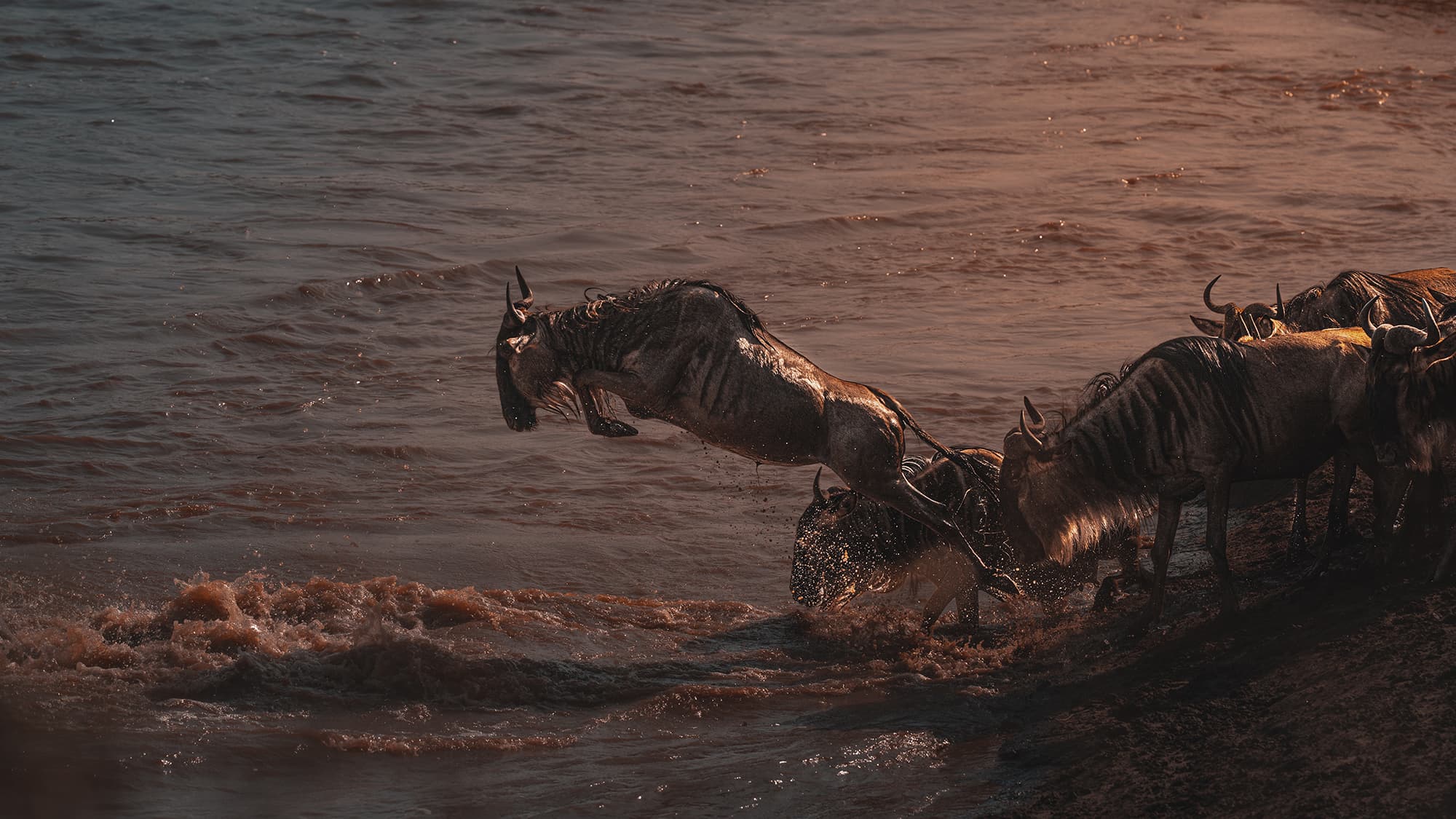
When a crossing begins, I usually look for the main entry point first.
I want the moment when a wildebeest leaves the bank and becomes airborne — separated for a fraction of a second from both the safety of land and the uncertainty of the river.
There is a tension in that instant that nothing else in the sequence quite has.
Once I have those photographs, I change how I am shooting.
Wider.
Then tighter.
Dust.
The shape of the herd.
Individual animals.
Animals struggling in the water.
Crocodiles.
Hippos.
Anything unexpected happening at the edges.
I do not want to spend the entire crossing pointing the camera at the same patch of water simply because that is where the most animals are.
Once I have made the essential documentary frames, I begin experimenting.
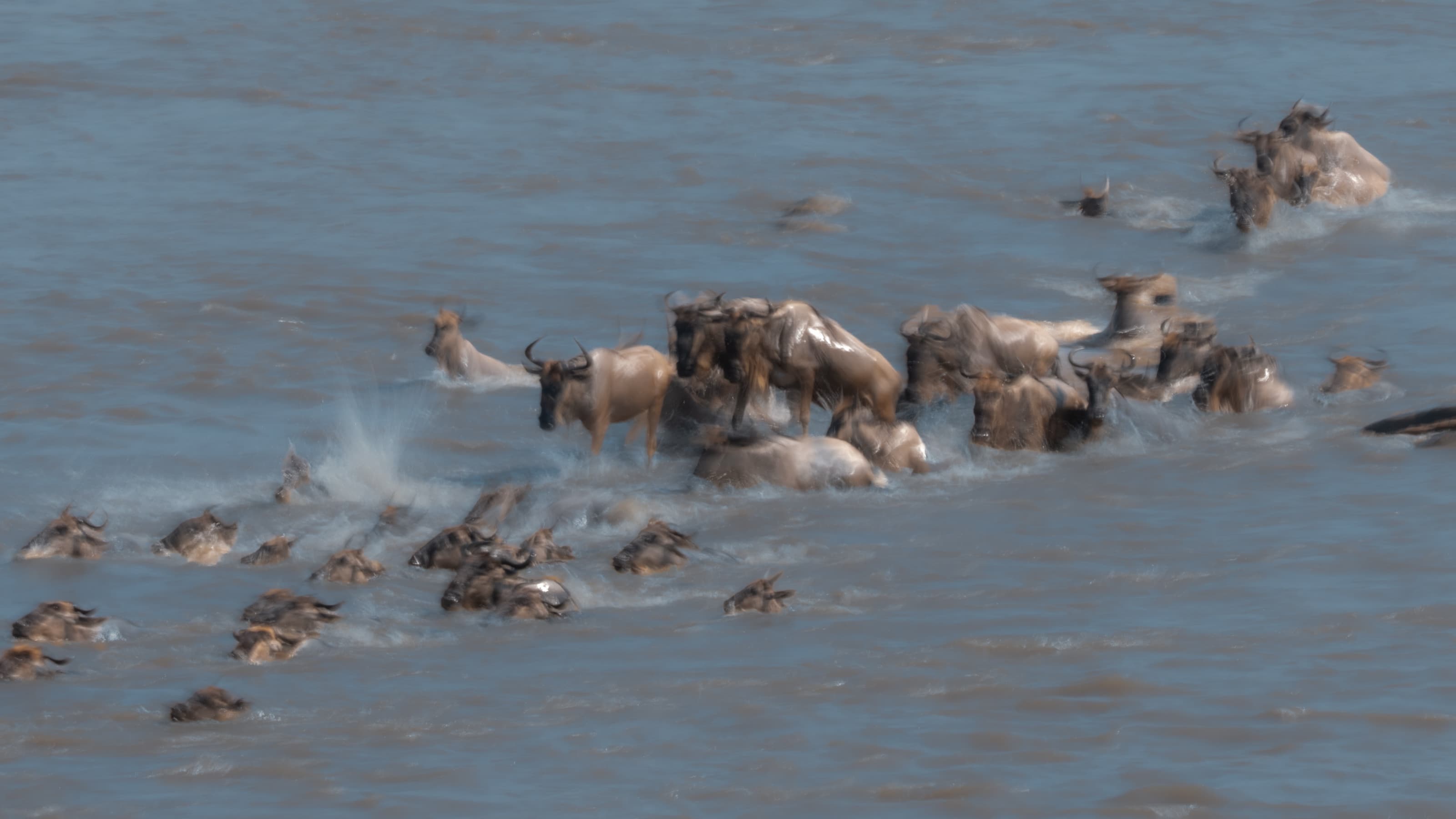
Sometimes I lower the shutter speed.
During one crossing, I photographed a few wildebeest relatively sharp on rocks in the river while animals moving around them became blurred streaks.
By then I was no longer trying to prove that a crossing had happened.
I was trying to photograph what migration feels like:
movement flowing around moments of stillness.
Don’t Decide the Story Is Over
One of the most useful lessons I have learned came near the end of a crossing.
The wildebeest had already been moving through the river for about twenty minutes.
Everyone had photographs.
The obvious action seemed to be over.
Some people began lowering their cameras.
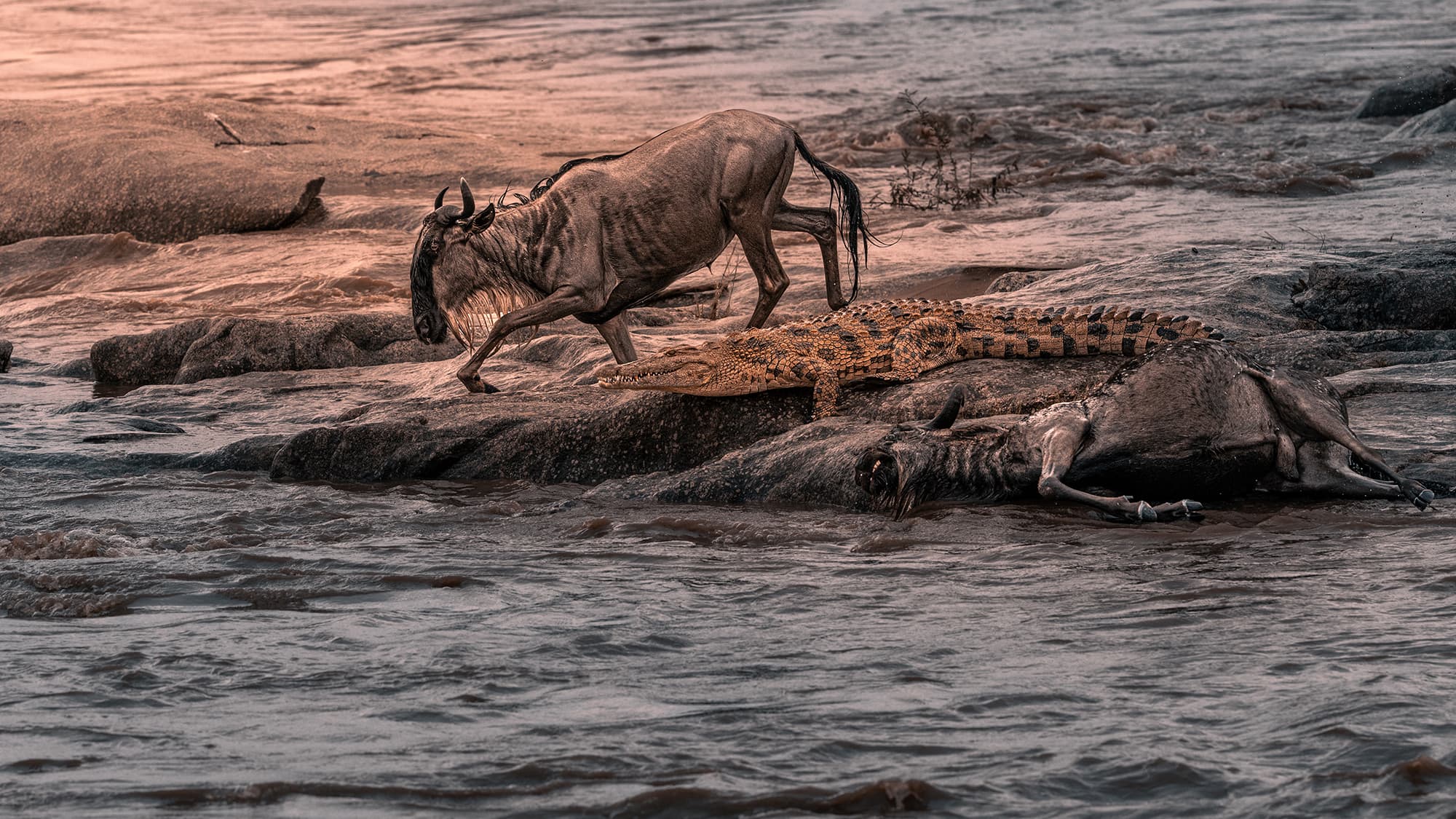
Then a crocodile took a young wildebeest.
It happened in seconds.
The only person in our vehicle who captured the moment was a photographer who happened to still be filming slow-motion footage.
Everyone else missed it.
The lesson was not simply:
Always watch for crocodiles.
It was bigger than that.
Photographers have a habit of ending stories in their own heads.
The climax has happened.
I have the photograph.
There is nothing left to see.
Wildlife does not follow our shot list.
As long as the animals are still there, the story may not be finished.
The Mara River Is More Dangerous Than the Spectacle Suggests
Crocodiles dominate the public image of Mara River crossings, but drowning is also a major and often underestimated source of mortality.
Long-term research on wildebeest mortality in the Mara River documented repeated mass-drowning events.
During detailed surveys from 2011 to 2015, researchers documented 23 mass drownings and estimated that an average of roughly 6,250 wildebeest carcasses entered the river each year over that period.
Those drownings were concentrated at only a subset of major crossing sites, suggesting that the physical characteristics of a crossing point and river conditions can influence how dangerous a crossing becomes.
That matters because a river crossing is not simply a dramatic photographic moment.
It is an encounter between animal movement and landscape.
Where the herd crosses matters.
The shape of the bank matters.
The river matters.
The photograph shows only one instant inside a much larger ecological system.
So, Can a Wildebeest Crossing Be Predicted?
Yes.
But prediction is not the same as certainty.
These are the signs I watch:
How many animals are gathering?
Which direction are they moving?
Are more groups arriving?
Are individual animals beginning to enter the water?
Are others following?
Is hesitation beginning to turn into collective movement?
Reading those signs can raise my confidence.
Confidence is not a promise.
In roughly ten situations I personally judged as highly likely to produce a crossing, about four still ended without the crossing I expected.
Again, that is not a scientific dataset.
It is an honest record of my own field judgement.
And it taught me something I did not expect.
Experience has not taught me how to know the future.
It has taught me when it is worth continuing to wait.
Those are very different things.
What Four Days of Waiting Actually Teach You
I have waited four days and ended up watching only 13 wildebeest cross.
I have waited four days and then watched more than 30,000 animals cross for roughly 25 minutes.
And I have had days when we saw three separate crossings.
Before you arrive, you do not know which version of the river you will get.
Every day is live.
There is no replay.
No director.
No guarantee that the light, the wildlife or the timing will cooperate with your itinerary.
This is why I often say:
Photography is the art of waiting.
But even that sentence is incomplete.
Waiting itself is not the point.
What matters is what happens to your perception while you wait.
On day one, you are mostly thinking:
Why haven’t they crossed yet?
By day four, you are watching herd density.
Direction.
Initiators.
Followers.
New animals arriving from behind.
False starts.
Changes in momentum.
Waiting does not guarantee a photograph.
Waiting teaches you how to see.
The One Photograph I Would Keep
If I could keep only one photograph from that crossing, it would not necessarily be the photograph with the biggest splash.
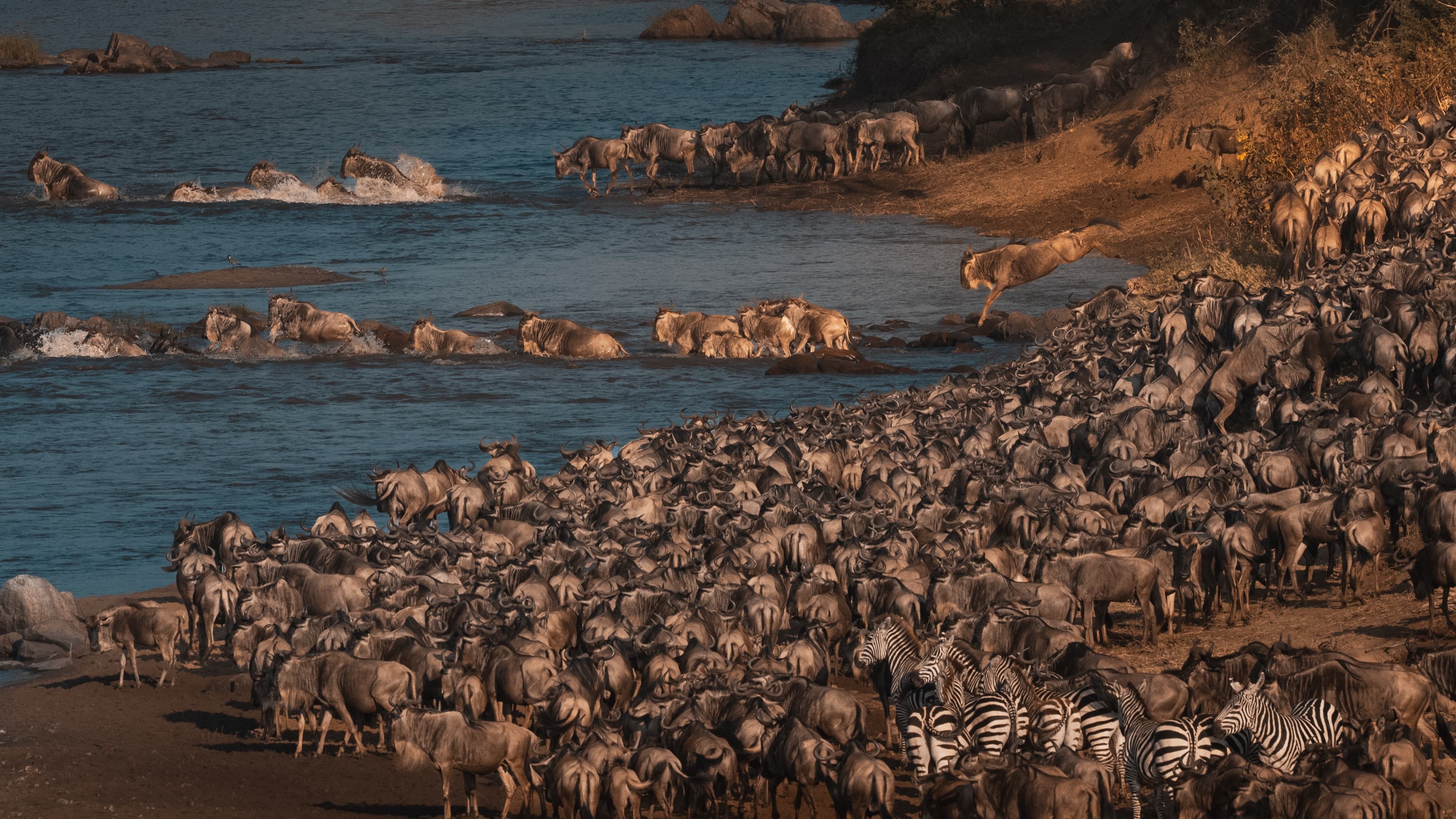
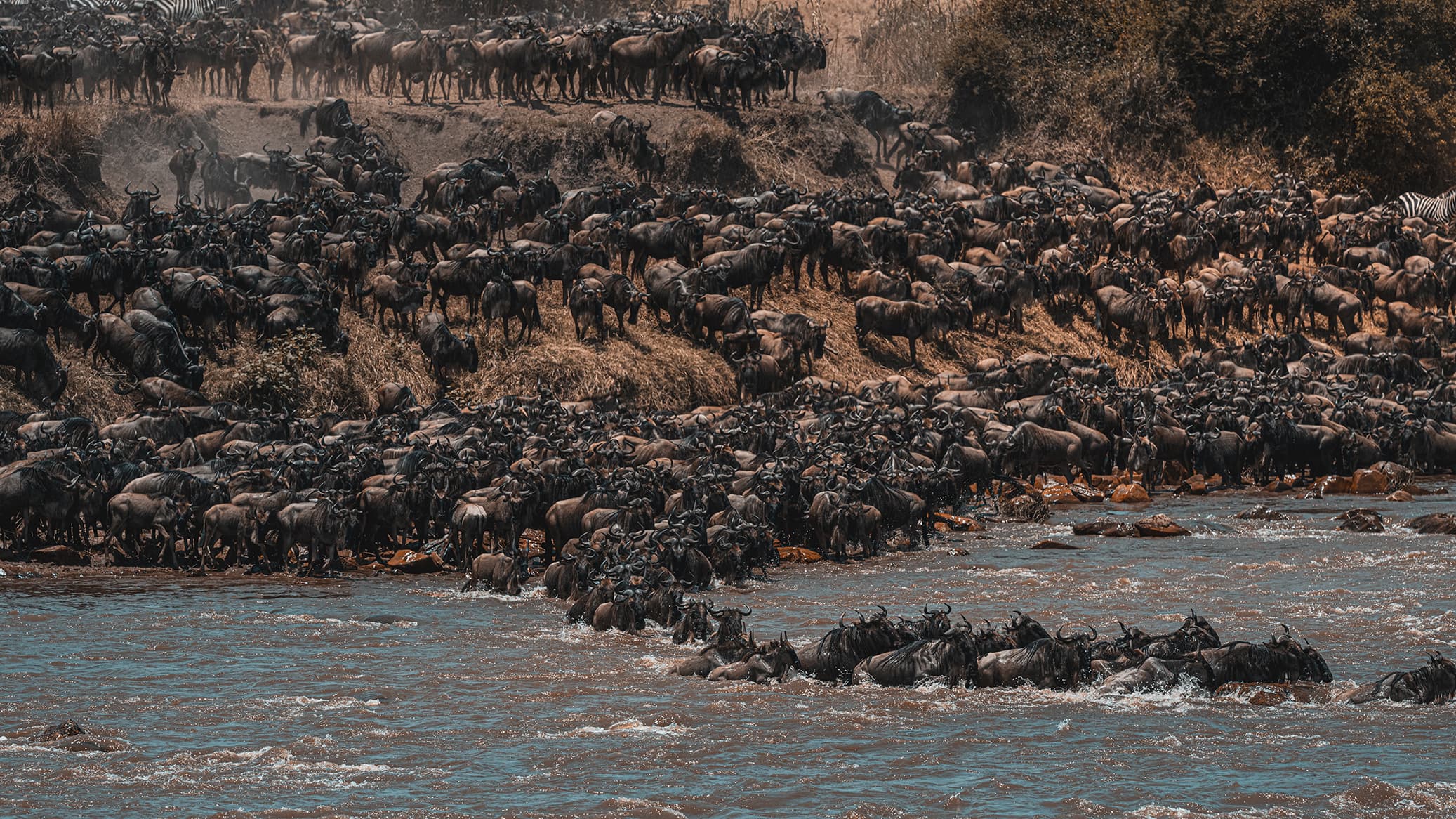
In the frame I remember most, a dense mass of wildebeest waits along the riverbank.
Farther away, animals already crossing form a moving stream toward the opposite side.
And in the middle of the frame, one wildebeest launches high into the air.
I like that photograph because it holds the whole story at once.
Waiting.
Scale.
Movement.
Decision.
And one individual moment inside a mass migration.
Thousands of animals are moving together.
But photography still comes down to a fraction of a second.
One decision.
One life.
One frame.
Prepare Yourself
When we have been sitting beside the river for a long time, I often tell the people with me:
Prepare yourself, and trust that everything is part of the best arrangement.
I do not say this because I believe patience guarantees a great photograph.
It doesn’t.
Nature guarantees nothing.
All we can do is give ourselves time.
Prepare the camera.
Train our eyes.
Keep our patience.
Keep watching.
And wait.
Because we never know whether the river will give us thirteen wildebeest —
or a living river made of thirty thousand.
We cannot control the result.
But we can decide whether we are ready when the moment finally arrives.
Frequently Asked Questions
Can you predict when wildebeest will cross the Mara River?
Partly. In the field, I look at herd size, direction of movement, whether new groups are still arriving, whether individual animals are beginning to enter the water, whether others follow, and whether hesitation is turning into collective movement.
These signs can raise the probability of a crossing, but they never guarantee one.
In my own field record, roughly four out of ten situations I judged “highly likely” still ended without the crossing I expected. This is a personal field observation, not a scientific probability.
How many days should you plan at the Mara River to see a wildebeest crossing?
I normally plan four days at the river for my photography groups.
During the 2026 migration season, two of my four groups waited three days without seeing a crossing and finally saw one on day four.
Four days does not guarantee a crossing. It simply gives us more opportunities to still be there when the herd decides to move.
What time of day do wildebeest cross the Mara River?
In my field experience, I have seen crossings happen at different times of day. There is no clock time I would use to guarantee one.
A herd may approach the river, retreat and return repeatedly before finally crossing, so I pay more attention to the behaviour of the animals than to the time on my watch.
How long does a wildebeest river crossing last?
It varies enormously.
The smallest crossing I have personally watched involved only 13 animals.
At the other extreme, I have watched more than 30,000 wildebeest cross for roughly 25 minutes.
The duration depends on how many animals commit to the crossing and whether the movement continues.
What are the main dangers to wildebeest during a river crossing?
Crocodile attacks are the most visually dramatic danger, but drowning can also cause substantial mortality.
Research on the Mara River documented repeated mass-drowning events, including 23 events between 2011 and 2015, with researchers estimating an average of roughly 6,250 wildebeest carcasses entering the river annually during that study period.
The risk also varies by crossing location and river conditions.
What camera settings work for photographing a wildebeest crossing?
My starting point for freezing action is usually around f/5.6–f/8, 1/2000 sec, Auto ISO and high-speed continuous shooting.
For fast jumping sequences, I prefer a high burst rate when the camera allows it. Depending on the light and camera system, I may also use a highlight-priority metering mode.
These are starting points rather than universal rules.
The most important thing is to have your camera configured before the crossing begins.
Research & Further Reading
Boone, R. B., Thirgood, S. J., & Hopcraft, J. G. C. (2006). Serengeti wildebeest migratory patterns modeled from rainfall and new vegetation growth. Ecology, 87(8), 1987–1994.
This research examines the relationship between rainfall, new vegetation growth and broad-scale wildebeest migration patterns. It helps distinguish the ecological forces driving migration across the Serengeti–Mara ecosystem from the short-term behavioural signals visible at an individual river crossing.
Torney, C. J., Hopcraft, J. G. C., Morrison, T. A., Couzin, I. D., & Levin, S. A. (2018). From single steps to mass migration: the problem of scale in the movement ecology of the Serengeti wildebeest. Philosophical Transactions of the Royal Society B, 373(1746), 20170012.
This paper explores how individual movement decisions, environmental information and social information can scale into collective migration — useful context for understanding why a large aggregation of wildebeest should not be treated as a single mind making one decision.
Subalusky, A. L., Dutton, C. L., Rosi, E. J., & Post, D. M. (2017). Annual mass drownings of the Serengeti wildebeest migration influence nutrient cycling and storage in the Mara River. Proceedings of the National Academy of Sciences, 114(29), 7647–7652.
This study documented repeated mass-drowning events in the Mara River and examined their ecological consequences. It provides important context for understanding that river crossings involve risks beyond the highly visible threat of crocodile predation.