Wild Life 02
Giza
A life in the dark.
African Leopard · Female · Laikipia, Kenya
Some animals are remembered because they are rare.
Others are remembered because, over time, they become known.
Giza is both.
She is a melanistic African leopard living in the Laikipia landscape of northern Kenya. Her dark coat made her extraordinary to the world.
But that is not why I remember her.
I remember her because I have been able to return.
To wait.
To watch.
And slowly, a black leopard stopped being simply a black leopard.
She became Giza.
This profile is being written. The identity, landscape and life-record facts are confirmed; the narrative sections below are in draft and await Nature Zi’s field text.
Field observation · Nature Zi
Not a species. An individual.
For most of my career I have photographed leopards as leopards — a rosette pattern, a posture, a species doing what the species does.
Giza is where that changed.
Returning to the same landscape, I began to recognise her: not from a record sheet, but from where she moves, the places she favours, and the particular rhythm of one life.
A melanistic leopard is easy to notice and hard to know. The dark coat draws every camera in the country. It tells you nothing about the animal underneath it.
Knowing an individual takes longer than seeing one. It takes returning.
Verified context
Laikipia, Kenya
Giza's world is Laikipia — a plateau of conservancies, ranch land and dry acacia country in northern Kenya, north-west of Mount Kenya.
It is not a fenced park. It is a working landscape, shared between wildlife, livestock and the people who manage both.
That matters to her story. A leopard can remain a wild individual only for as long as the land around her stays open enough to hold one.
Where Giza moves, and how safely, is not something this page will publish. The landscape is the world she belongs to; the ground she walks is hers to keep.
Field observation · Nature Zi
Darkness is where her world begins.
Leopards live at the edges of the day. Giza is most active after dark.
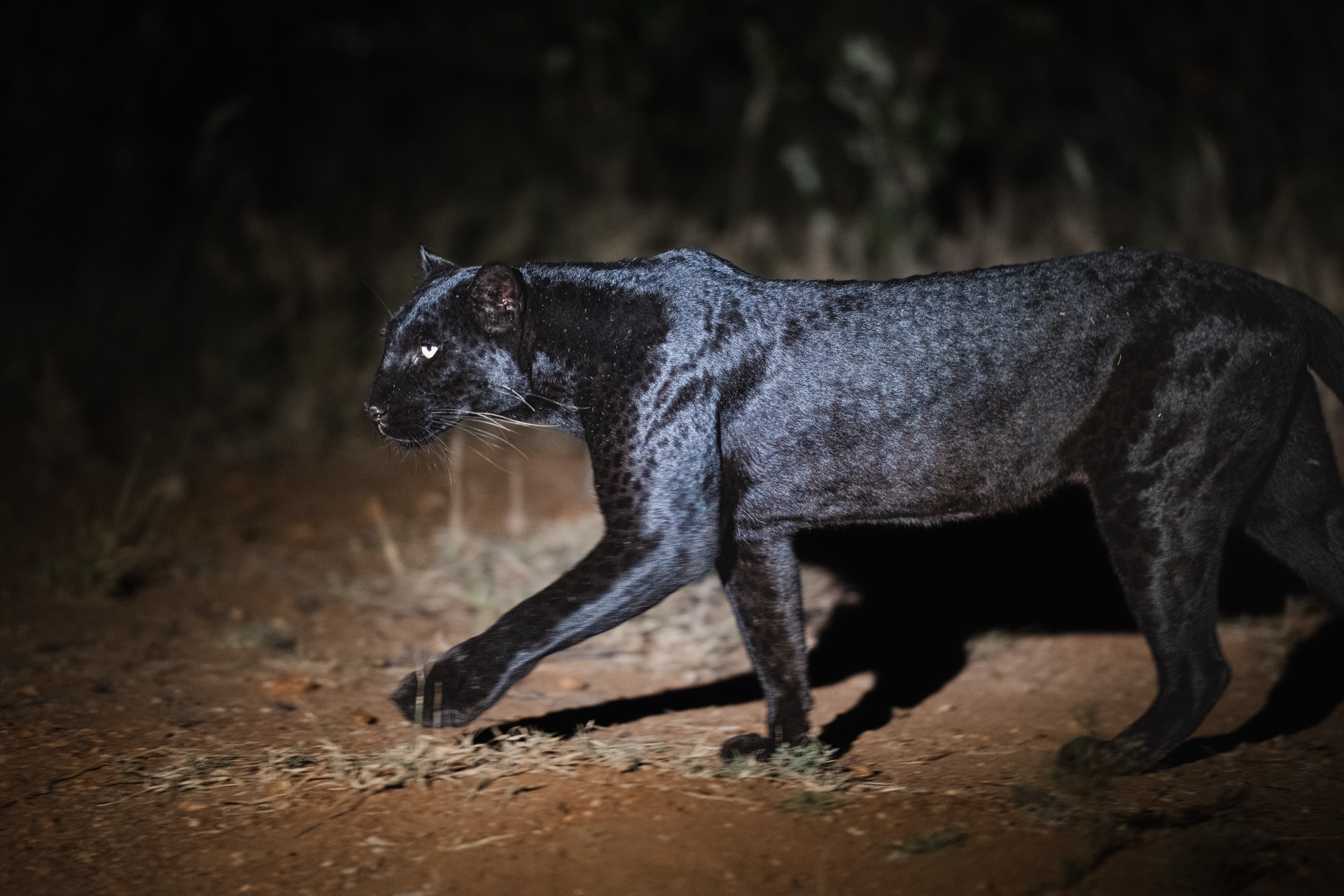
Photographing her means working at night, in the beam of a single light, against a background that gives almost nothing back. A melanistic leopard in the dark is nearly all shadow — an outline, a moving weight, two eyes catching the light.
Most of what can be learned about her is learned in those hours: where she crosses, how she hunts, whether she is alone.
The photographs from those nights are quiet. They are not spectacle. They record that she was there, and that someone was watching.
Interpretation
From cub to hunter.
Every adult leopard was once a cub that survived.
Giza was born in Laikipia; the date is not known to me. Like any leopard cub she would have spent her first months hidden, then learning — following her mother, watching hunts before making her own, and finally leaving to hold ground of her own.
I did not see any of that. By the time I came to know her she was already an independent adult female, hunting for herself.
What I can say is only what the present shows: a leopard that has come through the most dangerous part of a leopard's life, and is still here.
External field record
Then the story changed.
In 2025, Giza was seen with two cubs.
That observation is not mine. It comes from others in the landscape — guides and observers who know the area and know her — and it has been reported publicly. I record it here as an external field record, not as something I photographed.
It changes what Giza is. A leopard I had come to know as a solitary adult is now, at least for a time, a mother.
It also means there are cubs in the landscape whose location must never be published, and a female whose safety matters more than ever.
Life record
- Name
- Giza · Giza Mrembo
- Species
- African Leopard — Panthera pardus
- Sex
- Female
- Coat
- Melanistic
- Landscape
- Laikipia, Kenya
- Life stage
- Adult female
- Known offspring
- Two cubs observed in 2025external field record
- Status
- Wild · Free-ranging
- First recorded by Nature Zi
- Unknownto confirm
A life is made of moments.
Born in Laikipia
The date is not known.
Interpretation
Growing up
A leopard cub spends its first months hidden, then follows its mother and learns to hunt. None of this was observed.
Interpretation
Becoming independent
Young leopards leave their mother and take ground of their own. By the time Nature Zi came to know Giza, she was already an independent adult.
Interpretation
Becoming a hunter
As an adult, Giza hunts alone, mostly at night — the behaviour Nature Zi has watched most often.
Field observation · Nature Zi
2025
2025 — Motherhood
Giza was observed with two cubs. Reported by observers in the Laikipia landscape; not photographed by Nature Zi.
External field record
Today
Living and free-ranging in the Laikipia landscape.
External field record
Still wild.
Still unfinished.
What the photographs cannot explain alone.
Field notes on watching Giza — hunting in darkness, recognising an individual, reading movement, photographing black on black — will be published here as they are written.
No wild life is known alone.
Everything we know about an individual animal exists because someone stayed long enough to notice.
Trackers who recognise footprints.
Guides who remember where she crossed months before.
Researchers who compare observations.
Photographers who return.
Conservation teams protecting the landscape that allows her to remain wild.
Giza's story therefore does not belong to one photographer.
It is a story assembled from many witnesses.
Wild Lives exists to remember both the animal and those who made remembering possible.
Photographs
Recent updates
No verified public updates have been added yet.
Records & sources
- Laikipia field observers — Giza observed with two cubs (2025). credibleMultiple observers familiar with the landscape; publicly reported. A single citable public source is still to be confirmed.
Why This Life Matters
One day, there will be a last photograph of Giza.
We may not know it when we take it.
There will simply be a night when she walks into the darkness.
And another night when she does not return.
That is the nature of photographing wild lives.
We cannot keep them.
We cannot ask them to remain.
We can only pay attention while they are here.
Remember what we saw.
Record what we learned.
And leave enough space for them to continue living beyond our photographs.
She was here.
And someone remembered.